
What "Explicit" Really Means in Mathematics Education
A case for clarity, accuracy, and the sequence that builds understanding
By Esther White, CEO - Maths Australia
Australia is having the wrong argument about maths.
For three years the debate has been framed as a war between two tribes. On one side, "explicit instruction": teacher at the front, worked examples on the board, "I do, we do, you do," 80 per cent mastery before anyone works alone. On the other, "student-centred" learning: inquiry, problem-solving, real-world tasks, students discovering maths for themselves. Governments have picked the first tribe. Departments in New South Wales and Victoria now name explicit teaching as the school's main, in some documents the only, sanctioned pedagogy. Academics have lined up to defend the second. Everyone is being asked to choose a side.
I want to refuse the choice. The word at the centre of it has been quietly redefined, and almost nobody has noticed.
The word has been hijacked
Explicit does not mean scripted. It does not mean a slide deck. It does not mean a particular classroom-management routine or a fixed ratio of teacher talk to student silence. Open a dictionary. Explicit means clear, accurate, and fully expressed: nothing left implied, nothing left to chance.
That is a description of quality. It is not a description of a method.
Somewhere in the last few years, "explicit instruction" stopped meaning "teaching that is clear and accurate" and started meaning "a specific package of delivery techniques": the gradual release model, borrowed largely from reading research, applied wholesale to mathematics. The package got mandated. And because the package wears the word explicit on its label, anyone who questions the package is heard as arguing against clarity itself. That is a rhetorical trap, and it has made honest conversation almost impossible.
So let me be precise about where I stand.
I agree with the critics (the researchers at Deakin, at UNSW, at AARE) on one crucial point: explicit teaching should be a property of good instruction, not a mandated script. A method imposed from above, delivered from a universal slide deck, policed for fidelity, is not the same thing as teaching that is clear. Often it is the opposite. Scripts reduce the teacher to a reader. They optimise for consistency and classroom control, not for accuracy of understanding. You can deliver a perfectly compliant, perfectly scripted lesson that leaves a child no clearer about why than when they walked in.
And I part company with that same camp on their conclusion. Because the answer to a bad script is not less clarity. It is more.
Clarity is the goal. Sequence is how you reach it.
If explicit means clear and accurate, then the real question is not "should I teach explicitly?" but "what makes an explanation genuinely clear to a child who does not yet understand?"
The answer is one of the most robust findings in cognitive science, and it long predates the current fashion. Jerome Bruner described it in the 1960s: understanding is built in stages, enactive (through action), then iconic (through images), then symbolic (through abstract notation). John Sweller gave us the mechanism: the working memory of a learner is tiny and easily overwhelmed, so clarity is not about saying more, it is about reducing the load on that fragile system. Brian Butterworth showed us that number sense is a specific, physical capacity in the brain that can be built. Lynn Fuchs showed that when it does not develop on its own, structured intervention builds it.
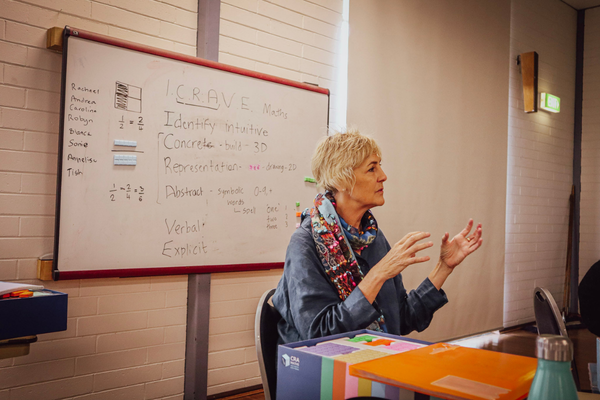
Put those together and you get a sequence: Concrete, Representational, Abstract. That is not one teaching option among many. It is the order in which the human mind actually assembles a mathematical idea. Teaching against that order is not a style choice; it is a source of confusion.
But the sequence only works if you honour its subtleties. This is where even well-intentioned "explicit maths" gets it wrong.
Concrete: one consistent tool, not a drawer full of them
The concrete stage is not "use manipulatives." It is use the same manipulative, consistently, until the structure it represents becomes automatic. Most classrooms rotate through counters, then blocks, then rods, then tiles, changing the tool every few weeks in the name of variety. Every change forces the child to re-learn the representation before they can think about the maths. That is extraneous cognitive load, added by the teacher, in the name of engagement. A single consistent tool, one that faithfully models the base-ten structure of our number system, lets the child stop thinking about the tool and start thinking with it. The tool becomes invisible. That is the point.
Consistency has to go all the way down, including to colour. When a value always wears the same colour, that colour becomes a stable anchor the brain can trust: the child sees the colour and the quantity comes for free, no working memory spent. Change it, and you break the anchor. Imagine if the grass were green today, brown tomorrow, blue the day after. You would stop being able to think about the field and start having to re-check the grass every morning. Imagine if a hundred-dollar note were pink one day, orange the next, purple the day after that; you would never build the instant, automatic recognition that lets you handle money without thinking. That is exactly what we do to children when the "ten" is red in one resource, blue in another, and undefined in a third. The mind craves a consistent world so it can stop watching the surface and start reasoning about the structure. Colour consistency is not decoration. It is one of the quiet ways we either protect a child's working memory or quietly tax it.
Representational: the child draws it, proportionally, accurately, themselves
This is the stage almost everyone collapses. "Representational" is usually taken to mean the teacher shows a picture, or the child copies a diagram, or draws a loose cartoon that stands in for the idea. That is not representation. That is decoration.
Real representation is the student drawing their own proportionally accurate picture of the quantity: a drawing where the size, the spacing and the structure actually correspond to the maths. A child cannot draw ten correctly as larger than seven, or a half as genuinely half, unless the concrete stage has already built the structure in their mind. The drawing is not an art activity. It is a test, a generative act that reveals whether understanding is there and deepens it when it is. This is Bruner's iconic stage done honestly, and it is exactly the kind of effortful retrieval that recent research confirms builds durable knowledge, rather than the shortcut that erodes it.
And proportional accuracy is not a nicety. It is the whole point, because it depends on the unit of measure. A representation that does not identify the unit, and does not size each part in true proportion to it, is not teaching place value. It is teaching a child that the size of a thing has nothing to do with its value, which is the precise opposite of what our number system means. Accurate proportion, anchored to a clear unit, is what makes the drawing true. A false picture is worse than no picture, because the child believes it.
Abstract: symbols last, added onto meaning
Only now do the symbols arrive. And they arrive as labels for meaning the child already holds, not as marks to be memorised first and understood later, if ever. This is the heart of what I mean when I say maths is a simple language. Language is symbols standing for meaning. You do not teach a child to read by drilling them on letter shapes before they have anything to say. You do not teach maths by drilling symbols before the child has a quantity in mind for those symbols to name. The abstract stage is the moment the child learns the notation for something they can already see, do, and draw. It is the easiest step, precisely because it is the last one.
Why this matters now
This is not a philosophical indulgence. Australia has a real problem, on a clock.
One in three Year 3 students is not reaching proficient numeracy. One in ten needs additional support before they have properly begun. In the 2023 TIMSS study, 13 per cent of our Year 4 students reached the advanced benchmark, against 22 per cent in England and 49 per cent in Singapore. And fluency, as the researchers now agree, is an equity issue: the child who is not fluent spends working memory recalling a multiplication fact that a fluent peer recalls for free, and so has less mind left for the actual problem. That gap does not stay still. It compounds, year on year, until the struggling child is simply out of their depth, and left behind.
At this exact moment, the national curriculum authority is reviewing the Foundation-to-Year-2 mathematics curriculum, with recommendations going to education ministers this term. Its own stated priorities are prioritisation of content and specific content sequencing. One of the researchers advising it has said plainly that the curriculum currently tells teachers what to teach but not when, and that a good curriculum should "take away the cognitive load for the teacher" by sequencing it for them.
That is exactly the argument being made here, now reflected in policy language. The country is, right now, deciding to care about sequence and cognitive load. The only question is whether it will do so accurately, honouring the subtleties that make a sequence actually work, or whether it will mandate another well-meaning script and call it explicit.
The position, in one breath
I am not calling for less structure. I am calling for more accurate structure.
I am not defending the mandated slide deck, and I am not defending discovery-learning-without-foundations either. I am saying that explicit, understood properly, means clarity and accuracy, and that clarity in mathematics has a shape. It is concrete before representational before abstract. It is one consistent tool, a proportionally accurate drawing by the child's own hand, and symbols added last, onto understanding that is already there.
Get the sequence right and maths stops being a wall to climb. It becomes what it has always been: a simple language, built one clear step at a time, that any child can learn to speak.
That is what explicit was always supposed to mean. It is time we used the word honestly.
Want to put explicit, multi-sensory maths instruction into practice?
Our evidence-based Multi-Sensory Maths Training Courses equip educators with the knowledge and practical strategies to teach mathematics through a clear, accurate and carefully sequenced approach, building strong foundations and supporting students to understand and master mathematical concepts.
Our training brings this approach together through the I-CRAVE Maths® Methodology, with practical strategies educators can apply with their students from foundational concepts through to multiplication, division, fractions, decimals and percents.
Explore Our Multi-Sensory Maths Training Courses.
References
Australian Curriculum, Assessment and Reporting Authority. (n.d.). F-2 mathematics iterative review. Retrieved July 20, 2026, from https://www.acara.edu.au/curriculum/curriculum-review
Bruner, J. S. (1966). Toward a theory of instruction. Belknap Press of Harvard University Press.
Butterworth, B. (2005). The development of arithmetical abilities. Journal of Child Psychology and Psychiatry, 46(1), 3-18. https://doi.org/10.1111/j.1469-7610.2004.00374.x
Fuchs, L. S., Fuchs, D., & Compton, D. L. (2012). The early prevention of mathematics difficulty: Its power and limitations. Journal of Learning Disabilities, 45(3), 257-269. https://doi.org/10.1177/0022219412442167
Sweller, J. (1988). Cognitive load during problem solving: Effects on learning. Cognitive Science, 12(2), 257-285. https://doi.org/10.1207/s15516709cog1202_4
Wernert, N., Schmid, M., & Rodrigues, S. (2024). TIMSS 2023 Australia. Volume 1: Student performance. Australian Council for Educational Research. https://doi.org/10.37517/978-1-74286-755-7