
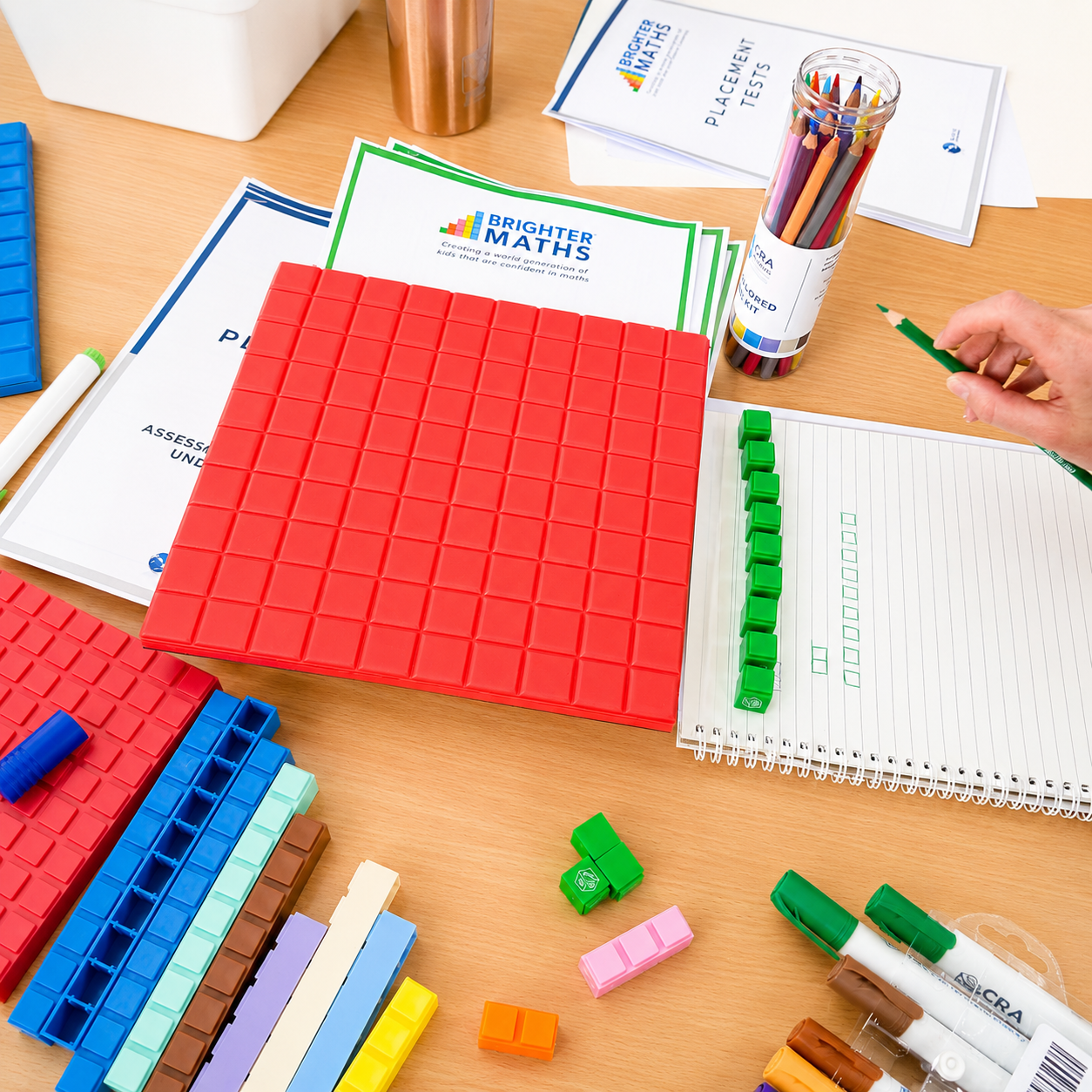
Brighter Maths: An Australian Multi-Sensory Maths Program Built for Understanding
When a student is struggling with maths, more practice is not always the answer.
We regularly see students who can complete a procedure one day but cannot explain it the next. Others rely heavily on finger counting, memorised rules or guessing. Some reach upper primary or secondary school with gaps in foundational number concepts that make each new topic increasingly difficult.
This is where we need to look beyond what a student is getting wrong and identify why.
Brighter Maths is an Australian multi-sensory maths program designed around a simple principle: students need to understand mathematics before they can be expected to use it confidently.
Designed for schools, tutors and homeschool families, Brighter Maths combines hands-on maths, explicit instruction, a Concrete–Representational–Abstract (CRA) progression and mastery-based learning within a clear, sequential program.
Rather than progressing according to age or year level alone, students begin at their current level of mathematical understanding and build from there.
When maths difficulties are really foundation difficulties
A student struggling with fractions may not have a fractions problem.
The difficulty may sit much earlier.
They may not have developed a secure understanding of multiplication. Place value may still be uncertain. Number relationships may have been memorised rather than understood. They may know a procedure without understanding the mathematics underneath it.
Continuing to introduce increasingly complex content without addressing those foundations places additional demands on the learner.
This is why Brighter Maths begins with Identify, the first element of the I-CRAVE Maths® Methodology.
Placement assessments help identify what the student understands, where gaps exist and an appropriate starting point for instruction. Students then progress sequentially from foundational number concepts through addition, subtraction, multiplication and division to fractions, decimals, percentages and more.
Progress is determined by mastery rather than simply moving forward because a new term or school year has begun.
A multi-sensory maths approach that makes mathematics visible
Mathematics becomes difficult when symbols have no meaning attached to them.
A student can memorise that 9 × 5 = 45 without understanding what nine groups of five actually means.
A multi-sensory maths approach allows us to make that relationship visible. A student can build the quantity using maths manipulatives, observe its structure, represent it visually, connect it to mathematical symbols and explain the relationship verbally.
Brighter Maths does this through I-CRAVE Maths®:
Identify what the learner understands and what needs to be taught.
Concrete experiences allow students to build and manipulate mathematical ideas.
Representation connects those experiences to drawings, diagrams and visual models.
Abstract connects understanding to numerals, symbols and mathematical notation.
Verbal develops mathematical language and requires students to communicate their thinking.
Explicit ensures concepts are deliberately taught, modelled, practised and checked.
The manipulatives are therefore not an activity added simply to make maths more engaging. They have an instructional purpose: helping students connect quantity, structure, language, representation and mathematical notation.
From concrete to abstract, without leaving understanding behind
The Concrete–Representational–Abstract approach, often called CRA maths, provides an important bridge between hands-on learning and abstract mathematics.
The goal is not for students to remain dependent on manipulatives.
The goal is to use concrete materials purposefully while understanding develops, then connect those materials to visual representations before expecting students to work confidently with abstract symbols.
For example, rather than moving directly from building a multiplication problem to writing an equation, Brighter Maths deliberately includes the representational step: build it, draw it, write it and say it.
That drawing stage matters because it provides a bridge between a three-dimensional concrete model and abstract symbolic notation.
This progression is reflected throughout Brighter Maths so students are not continually learning unrelated representations and procedures. New mathematical knowledge is connected to what they already understand.
From Math-U-See to Brighter Maths: building on more than 25 years of experience
For more than 25 years, Maths Australia supported Australian and New Zealand families and educators using Math-U-See, an American multi-sensory maths program developed by Steve Demme.
Esther White first used Math-U-See while homeschooling her five daughters. After seeing the value of the approach, she brought the program to this region in 2000 and, with permission from Steve Demme, developed the Australian, New Zealand and Asian Metric Edition of the program available at that time.
That experience forms an important part of Maths Australia's history.
It also gave our team decades of direct experience working with homeschool families, tutors, teachers and students using a hands-on, mastery-based maths approach.
As research and practice in education continued to develop, so did our understanding of how mathematics instruction could be strengthened.
Brighter Maths grew from that experience.
Building on more than two decades of practical knowledge, Maths Australia developed Brighter Maths, an Australian program that retains the value of sequential, multi-sensory and mastery-based mathematics while incorporating our current approach to explicit instruction, cognitive load, representation, learning differences and the Science of Learning.
Brighter Maths also allowed us to create Australian video instruction, lesson plans, assessments, student resources and contextual examples, and to align the program more closely with the Australian Curriculum.
For families and educators who have previously used Math-U-See, the transition has been deliberately kept simple. The Brighter Maths colour levels correspond sequentially with the earlier Math-U-See levels, allowing students to continue building on what they have already learnt.
It isn't about dismissing what came before.
It is about taking more than two decades of practical experience with multi-sensory mathematics and continuing to refine the way we teach.
Mastery-based maths means knowing when to move forward
One of the challenges for teachers, tutors and homeschool parents is deciding when a student is ready for the next concept.
Moving too quickly can create gaps. Remaining on material the student has already mastered can create frustration and disengagement.
A mastery-based maths program provides a clearer pathway.
Brighter Maths uses an 80% mastery benchmark to help determine readiness to progress. Assessment informs teaching: when understanding is not yet secure, the educator can identify where further instruction and practice are required.
This is particularly useful within a numeracy intervention program, where two students of the same age may have very different mathematical needs.
The question changes from:
What should a student of this age be doing?
to:
What does this student understand, and what do they need to learn next?
That is a much more useful starting point for targeted maths intervention.
Designed with how students learn in mind
Brighter Maths draws on principles consistent with Cognitive Load Theory, explicit instruction, Universal Design for Learning (UDL), Response to Intervention (RTI), Multi-Tiered Systems of Support (MTSS) and the broader Science of Learning.
These frameworks are not interchangeable, but together they provide useful guidance about effective teaching.
Working memory has a limited capacity for processing unfamiliar information. Effective instruction therefore needs to manage the amount of new information students are expected to process at once.
In practice, this means carefully sequencing concepts, connecting new learning to existing knowledge, explicitly modelling unfamiliar processes, providing guided practice and gradually moving students towards independence.
This is reflected in the structure of Brighter Maths.
Rather than asking students to discover essential mathematical relationships for themselves, concepts are explicitly taught and modelled. Students then build, represent, verbalise and practise the mathematics before moving towards greater abstraction and complexity.
Supporting dyscalculia and diverse learning needs
For students with dyscalculia, dyslexia, ADHD, autism, working-memory difficulties or other learning differences, mathematics can become particularly difficult when instruction moves quickly to abstract symbols or assumes foundational knowledge that is not yet secure.
A structured dyscalculia maths support approach may therefore include explicit instruction, carefully sequenced learning, visual and concrete representations, repeated opportunities for practice and regular checks for understanding.
These principles are embedded throughout Brighter Maths.
Importantly, they are not reserved for students with a diagnosis.
Clear explanations, maths manipulatives, manageable instructional steps, multiple representations and systematic progression can support a wide range of learners.
One program across schools, tutoring and homeschool maths
Brighter Maths was designed to work across different educational settings.
In schools, it can provide a structured numeracy intervention pathway, helping educators identify gaps and deliver targeted instruction to individuals and groups across Tier 1, Tier 2 and Tier 3 settings. It is also successfully used in special education settings, including with students with physical and intellectual disabilities and other learning differences.
For tutors, it provides a sequence to follow. Instead of assembling disconnected worksheets and activities, tutors can identify a student's starting point, explicitly teach concepts and monitor progress towards mastery.
For homeschool families looking for an Australian homeschool maths program, Brighter Maths provides structure while allowing students to progress at their own pace. Families have access to Australian video instruction and resources using Australian terminology, metric measurement and currency.
Across each setting, the underlying teaching sequence remains consistent:
Find the point of need. Make the mathematics concrete. Represent it. Develop mathematical language. Connect understanding to symbols. Check for mastery. Then build the next layer.
When maths begins to make sense
One homeschool parent described the difference simply:
"My daughter is much more comfortable with the way Brighter Maths is structured. I have found her thrive through your videos. I personally like the brighter maths worksheets too, the thoroughness and variety."
Another parent shared:
"Thank you so much! We received our Brighter Maths Book today and it was absolutely amazing. The timing couldn’t have been more perfect, as we started back homeschooling today, and it was the very first work my daughter began with. She really likes the new Brighter Maths book very much! A big thank you to your whole team. The way the exercises are set out in the Brighter Maths workbooks is even better... there’s more room to work, the layout is clear, and the examples are easy to follow. We’re so grateful and excited to continue using it!"
Individual experiences will differ, but they illustrate something fundamental to mathematics education: changing the way a concept is taught can change a student's opportunity to understand it.
Maths should not feel like a collection of disconnected rules to remember.
It should make sense.
Whether we are teaching a young child beginning number concepts, supporting an older student with significant gaps, providing targeted maths intervention or teaching fractions to a homeschool learner, the principles remain remarkably consistent.
Start with what the learner understands.
Teach explicitly.
Make abstract ideas visible.
Build one concept securely upon another.
Move forward when the student is ready.
That is the thinking behind Brighter Maths.
Maths Australia provides practical, evidence-based training that shows educators how to teach mathematics with clarity and confidence using the I-CRAVE Maths® Methodology.
If you are supporting students who are disengaged, stuck or missing important mathematical foundations, you can explore Brighter Maths via this link and view the comprehensive multi-sensory maths training courses.