
Multi-Sensory Homeschool Maths: Setting Up a Hands-On Learning Space at Home
Somewhere in most homeschool homes there's a tub of maths manipulatives. Base ten blocks, counters, fraction tiles, maybe a set of pattern blocks bought with good intentions. They get used enthusiastically for the first fortnight. Then, gradually, they don't.
Not because the parent stopped believing in hands-on homeschool maths. Usually it's simpler than that. Getting the tub down from the shelf, clearing space on the table, and putting everything away afterwards takes longer than just handing over a worksheet. On a normal Tuesday morning, the path of least resistance wins, and the blocks stay in the cupboard.
If this sounds familiar, the problem was never a lack of commitment to hands-on homeschool maths. It's that the setup made the concrete option the harder one.
Reframing the Problem
The common assumption is that hands-on homeschool maths requires a dedicated maths corner, a full shelf of resources, or the kind of colour-coded setup that looks good in a photo. So parents either invest heavily upfront or quietly give up, assuming they don't have the space or the materials to do it “properly.”
Neither is really the issue. The materials themselves rarely determine whether hands-on teaching happens. What determines it is friction: how much effort it takes, in that exact moment, to reach for something concrete instead of reaching for a pencil.
A single well-chosen resource that's already sitting within arm's reach will get used far more often than an entire cupboard of manipulatives that requires a five-minute setup first.
The Core Insight: Design for the Moment, Not the Cupboard
Children build mathematical understanding by handling something real before they're asked to work with it in symbols. That much is well established. What's less often said is that this only happens consistently if going concrete is at least as easy as not going concrete.
Hands-on homeschool maths isn't a resourcing problem. It's a workflow problem. The question worth asking isn't “do I own the right materials?” It's “when my child sits down for maths today, is the right material already within reach for what we're about to learn?” A small, current, accessible setup will outperform an impressive but buried one every time.
A Simple Framework for the Space Itself
The I-CRAVE Maths® Methodology is usually applied to how a concept is taught. It's just as useful for how a learning space is organised.
Identify what's actually being taught this fortnight, and keep only those materials visible. A space with every resource you own laid out is as overwhelming for a child as a workbook with ten concepts on one page.
Concrete materials for the current topic live in one small, fixed spot - a tray, a labelled basket, a shelf at the table - so getting them out takes seconds rather than a search. If it takes longer to find the blocks than to do the worksheet, the blocks lose.
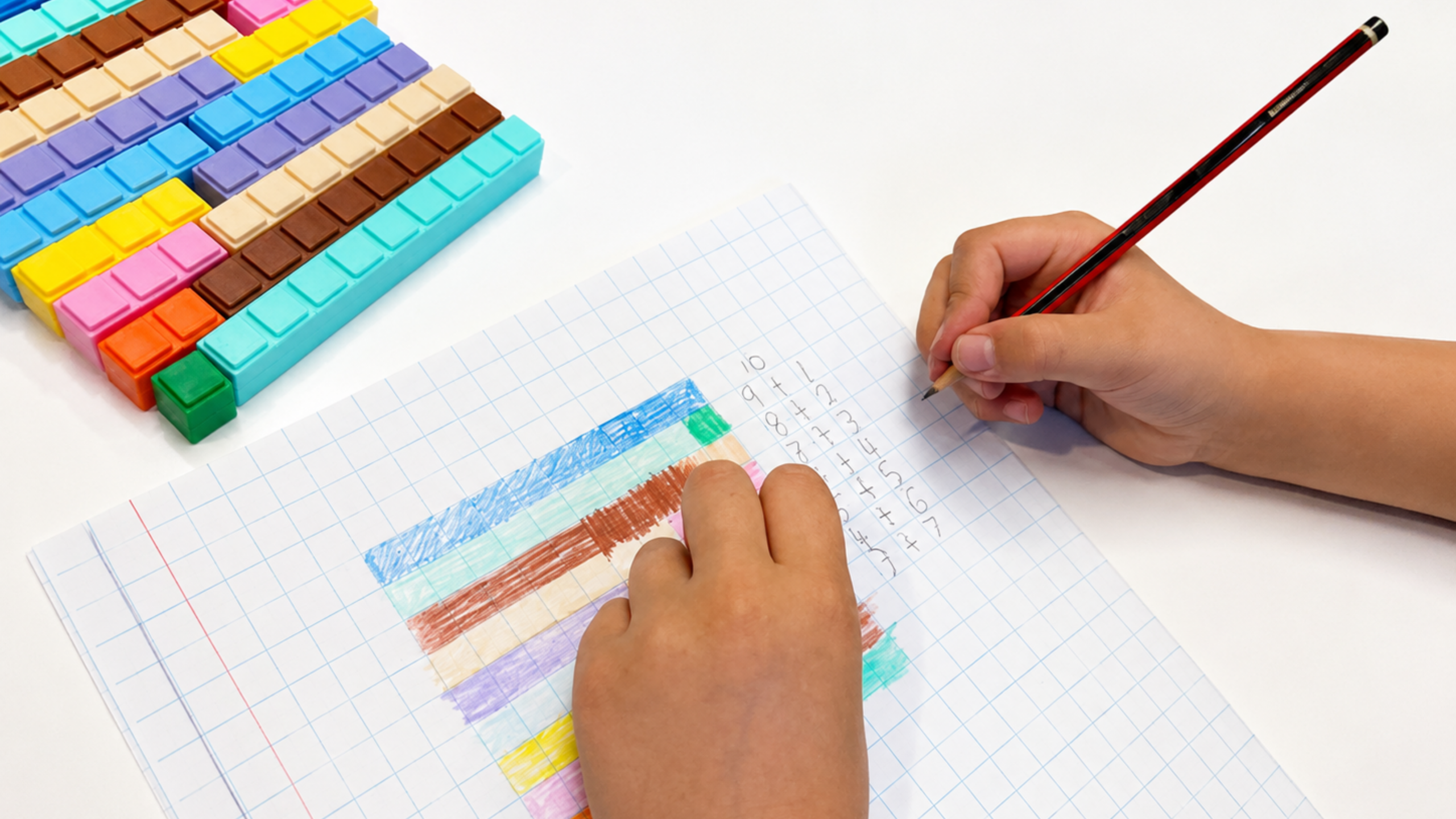
Representation needs a home too. A small whiteboard or a pad of grid paper kept next to the materials means your child can move from building something to drawing it without leaving the table or breaking their concentration.
Abstract practice, the written page, stays nearby but appears last. Keeping it slightly out of immediate reach, rather than already open on the table, protects the order lessons need to happen in.
Verbal checks are easy to forget in the moment, so a simple prompt card near the space, something as plain as “show me, then tell me why”, is often enough to remind you to ask before moving on.
Explicit structure comes from rotating what's on display. Materials for last term's concepts get packed away once mastered, so the space always reflects what's being taught now, not everything you've ever bought.
What This Looks Like in a Real Homeschool Setup
In practice, this is rarely more than a shoebox-sized tray kept on a shelf near the kitchen table, holding whatever materials suit the concept currently in progress, alongside a small whiteboard and a handful of markers.
When maths time arrives, the materials are already there. There's no five-minute detour to find anything, so the lesson starts hands-on by default instead of starting at the worksheet because that was quicker to reach.
The shift shows up quickly. Lessons that used to open with reluctance tend to start more easily once the setup friction disappears. Many parents also notice they stop feeling like they're “running a program” and start feeling like they're simply teaching, because the materials support the lesson instead of requiring one of their own.
Why This Works
None of this is really about tidiness. Cognitive Load Theory explains why friction matters as much as it does: every extra decision or delay before a lesson starts draws on the same limited attention a child needs for the maths itself. Remove the unnecessary decisions and there's more capacity left for the concept.
Explicit instruction relies on consistency - a clear, predictable structure that a child can rely on lesson after lesson. A stable, current learning space is simply that consistency made physical. And within a Response to Intervention (RTI) view of home teaching, environment carries more weight than it does in a classroom, because there isn't a second adult to catch a gap if a concept is rushed. A well-designed space quietly does some of that protective work on its own.
What Changes for the Parent
Once hands-on homeschool maths is built into the setup rather than left to willpower each morning, the guilt tends to disappear first. It stops being a daily decision about whether you have the energy to “do manipulatives today,” because the materials are already positioned to be used.
Lessons become more predictable, for the same reason a predictable classroom routine helps a room full of students settle in faster. And the resources you already own finally get used, not because you've found the perfect kit, but because the one you have is finally in the right place at the right time.
Maths Should Make Sense, With What's Already at Hand
Hands-on homeschool maths was never about owning more, or building a picture-perfect corner of the house. It's about making sure the right material is close enough, at the right moment, that reaching for it is the easy choice rather than the effortful one.
When a home learning space is designed this way, maths stops depending on how much energy is left in the day, and starts making sense the way it's meant to - through something a child can see, touch and build before they ever need to explain it on paper.
Bring hands-on maths into your learning space
Brighter Maths makes multi-sensory maths practical for home educators, with structured lessons, hands-on manipulatives and a clear learning sequence designed to help children see, touch and truly understand maths.
Built around the I-CRAVE Maths® Methodology, Brighter Maths guides children from concrete, hands-on learning through to written mathematics, helping them build strong foundations, genuine understanding and confidence along the way.
Explore Brighter Maths.