
Homeschool Multiplication Games Using Integer Blocks
For many homeschool families, multiplication is one of the first areas where confidence begins to waver.
A child may happily count, add and subtract, but as soon as times tables are introduced, learning can become frustrating. Lessons start to feel repetitive, flashcards lose their appeal, and practice turns into something both parent and child begin to dread.
Often, the problem isn't a lack of effort. It's that multiplication has become something to memorise before it has become something to understand.
That's why the best homeschool multiplication games don't simply encourage children to remember answers. They help children build mathematical understanding through hands-on exploration, discussion and discovery.
Learning Through Play Doesn't Mean Learning Without Purpose
Many educational games are enjoyable, but not all of them build deep mathematical understanding.
A meaningful multiplication game should have a clear learning goal.
It should help children recognise equal groups, identify patterns, explain their thinking and make connections between multiplication and division.
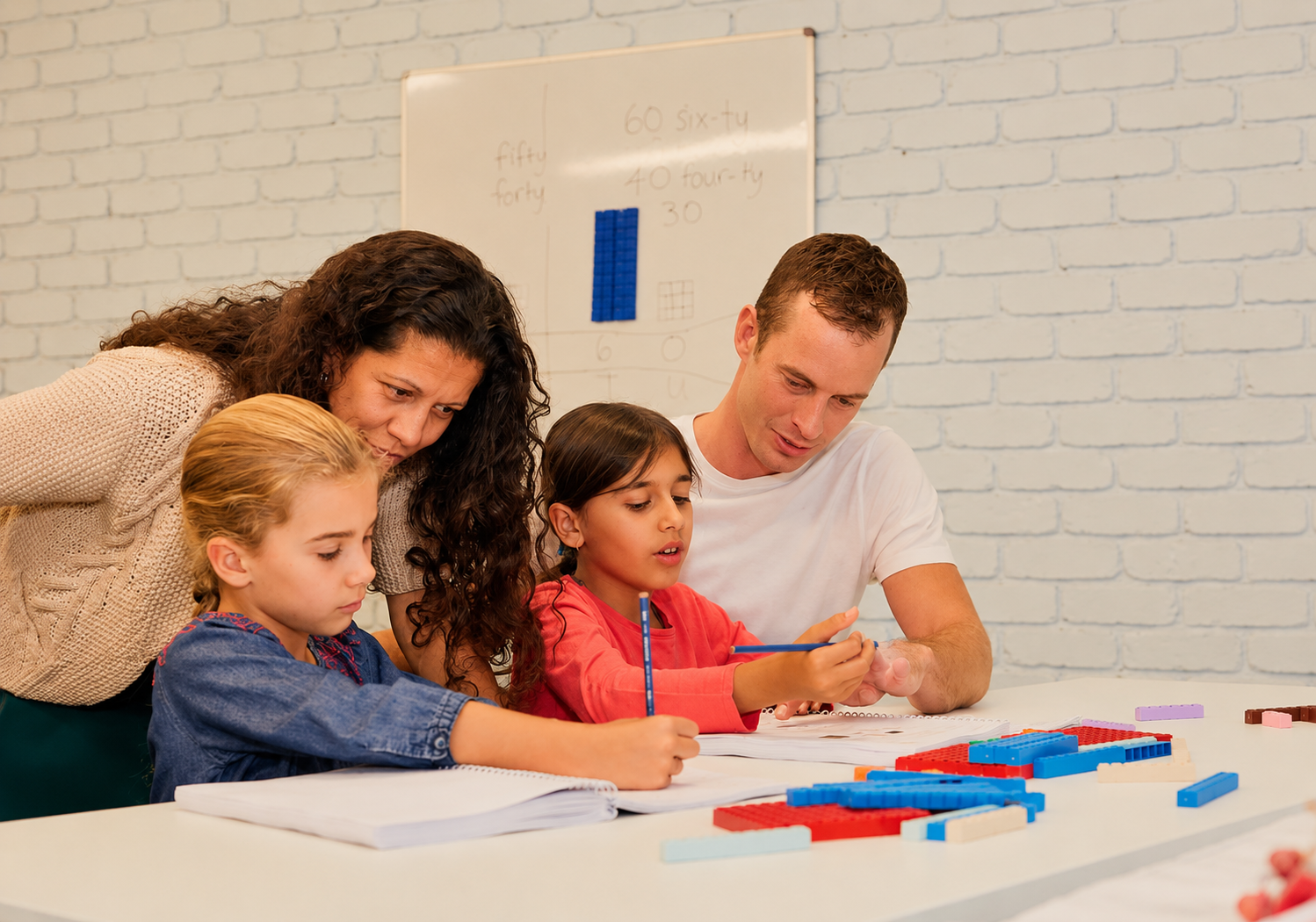
Integer Blocks are particularly effective because they allow children to physically build the mathematics they are learning.
Rather than imagining multiplication, they can see it, touch it and manipulate it.
Learning becomes active rather than passive.
Why Hands-On Learning Matters
Multiplication is an abstract idea.
For many children, expecting them to memorise multiplication facts before they understand what multiplication represents is like expecting them to read a book before learning the alphabet.
Hands-on materials bridge that gap.
Using Integer Blocks, children can build equal groups, create arrays, compare quantities and discover mathematical relationships for themselves.
These concrete experiences make multiplication easier to understand and far easier to remember.
Using the I-CRAVE Maths® Methodology at Home
The I-CRAVE Maths® Methodology provides a simple sequence that homeschool families can follow naturally during everyday lessons.
Identify
Begin by discussing the problem together.
What are we trying to find?
How many equal groups are there?
How many are in each group?
This simple conversation encourages children to think before they calculate.
Concrete
Children build the problem using Integer Blocks.
For example, to explore 4 × 5, they make four equal groups with five blocks in each.
They count the total.
They rearrange the groups.
They compare different arrangements.
The mathematics becomes visible.
Representation
Once children have built the groups, encourage them to draw what they made.
Circles containing equal groups, simple arrays or diagrams all help strengthen understanding.
Drawing creates another connection between the concrete materials and the mathematical idea.
Abstract
Only after children understand what they have built do they write the equation.
4 × 5 = 20
20 ÷ 5 = 4
20 ÷ 4 = 5
Rather than memorising disconnected facts, they begin recognising relationships.
Verbal
Ask children to explain their thinking.
Can they describe what they built?
Can they explain why the answer makes sense?
These conversations often reveal far more about understanding than simply checking whether an answer is correct.
Explicit
Parents guide each activity with clear demonstrations before encouraging children to work independently.
This gradual progression helps children develop confidence without feeling overwhelmed.
Five Homeschool Multiplication Games Using Integer Blocks
Games are most effective when they reinforce understanding rather than simply reward speed.
Build the Mystery Groups
Choose a multiplication fact without saying it aloud.
For example, secretly choose 3 × 6.
Ask your child to build equal groups until they think they have discovered the problem.
Once they've built it, discuss how they knew.
Then reverse the roles and let your child choose the multiplication problem.
This develops reasoning alongside multiplication.
Array Challenge
Call out a multiplication fact.
Your child builds it as an array using Integer Blocks.
Next, ask them to rotate the array.
What changed?
What stayed the same?
Children quickly discover that 4 × 7 and 7 × 4 produce the same total while looking different.
This builds understanding of the commutative property naturally.
Find the Missing Group
Build several equal groups but remove one before your child sees the finished model.
Can they work out how many blocks are missing?
Can they explain their reasoning?
This encourages flexible mathematical thinking rather than simple recall.
Multiplication Detective
Build an array and ask questions instead of giving answers.
How many rows do you see?
How many are in each row?
How many altogether?
What division facts can you make from this model?
Children begin seeing multiplication and division as connected ideas.
Race to Build
Write several multiplication facts on cards.
Take turns selecting a card and building the model with Integer Blocks.
The winner isn't the person who finishes first.
The winner is the person who can explain their mathematical thinking most clearly.
This keeps the focus on understanding rather than speed.
What You'll Notice as Understanding Grows
When multiplication is taught through hands-on experiences, something begins to change.
Children rely less on counting by ones.
They begin recognising patterns across different multiplication facts.
They explain their thinking more confidently.
Division starts making sense because they can see the equal groups.
Perhaps most importantly, mistakes become opportunities for discussion rather than signs of failure.
Instead of simply correcting an answer, parents can ask:
"Can you show me with the blocks?"
The materials provide immediate feedback that helps children identify and correct misconceptions independently.
Why This Approach Works
Research into the Science of Learning consistently highlights the importance of building conceptual understanding before expecting automatic recall.
Cognitive Load Theory reminds us that working memory is limited. Concrete materials reduce unnecessary mental effort by allowing children to see the mathematical relationships they are learning.
Explicit Instruction supports this process by introducing one concept at a time, modelling clearly and providing guided practice before expecting independent work.
For children who need additional support, this approach also aligns well with Response to Intervention (RTI) principles by strengthening foundational understanding before increasing complexity.
Rather than practising errors repeatedly, children build correct mathematical thinking from the beginning.
What Changes for Homeschool Families
One of the greatest benefits of using Integer Blocks is that multiplication lessons often become calmer.
Parents no longer feel they need to convince children to memorise endless facts.
Children begin asking questions, making discoveries and explaining their reasoning.
Lessons become conversations instead of drills.
Parents gain confidence because they can see exactly how their child is thinking.
Children gain confidence because the mathematics makes sense.
Learning becomes something they experience, not something they simply try to remember.
Building Understanding That Lasts
Fluency with multiplication facts is an important goal, but lasting fluency grows from understanding.
When children can build equal groups, create arrays, explain relationships and connect multiplication with division, they develop knowledge that stays with them long after the lesson has finished.
The best homeschool multiplication games are not simply about making maths more enjoyable.
They are about making maths meaningful.
When children understand what multiplication represents, confidence grows naturally - and learning becomes something they genuinely enjoy.
Want to turn hands-on multiplication into lasting understanding?
If your child is ready to move beyond memorising times tables, Brighter Maths provides a structured, multi-sensory pathway for building multiplication and other essential maths concepts through genuine understanding.
Using hands-on materials, explicit teaching and the I-CRAVE Maths® Methodology, Brighter Maths helps home educators identify learning gaps, build strong mathematical foundations and guide children from concrete understanding towards confident, independent maths learning.
Explore Brighter Maths.