
When Students Learn the Procedure but Not the Mathematics
Most teachers have seen students complete regrouping problems correctly during guided practice, only to become confused the moment the numbers change slightly.
Some students can explain the steps of the algorithm but cannot explain why those steps work. Others become completely dependent on memorised procedures, carefully following rules without understanding the quantities underneath them.
This often becomes visible during addition and subtraction involving regrouping.
Students may write digits in the correct columns and repeat instructions such as "carry the one" or "borrow from the tens," yet still seem uncertain throughout the process.
Teachers frequently respond with more practice.
More examples. More correction. More repetition of the steps.
But many regrouping difficulties are not procedural problems.
They are understanding problems.
This is why educators who teach regrouping with manipulatives often see stronger long-term understanding than those relying on algorithms alone.
Students need to experience quantity relationships physically before abstract procedures begin making sense.
Regrouping Is About Quantity Exchange
One of the most common misconceptions in primary maths instruction is treating regrouping as a sequence of procedural rules rather than a system of quantity relationships.
Students are often taught what to do before they understand what is happening mathematically.
For example, a student solving:
28 + 7
may be told to "carry the one" without understanding that ten ones have been regrouped into one ten.
Similarly, during subtraction, students may hear:
"Borrow from the tens column."
Yet the mathematics actually involves exchanging one ten for ten ones.
These distinctions matter deeply.
When students rely only on procedural language, maths can feel arbitrary and fragile. The steps may work temporarily, but understanding often breaks down once numbers become larger or less familiar.
Students need opportunities to see regrouping as quantity exchange, not rule-following.
Why Bridging to Ten Matters
Bridging to ten is one of the most important foundations underneath regrouping.
It helps students recognise that numbers can be reorganised flexibly while maintaining the same overall value.
For example:
8 + 5
can become:
8 + 2 + 3
which then becomes:
10 + 3
This strategy strengthens number relationships and supports mental flexibility.
Importantly, students should not simply memorise bridging strategies procedurally.
They need to experience them concretely first.
When educators teach regrouping with manipulatives, students can physically move quantities to create groups of ten. They see the exchange happening rather than trying to imagine it abstractly.
This matters because our number system is organised around groups of ten.
Students who understand this structure conceptually are far more likely to develop secure addition and subtraction understanding later.
Using Concrete, Representational, and Abstract Learning
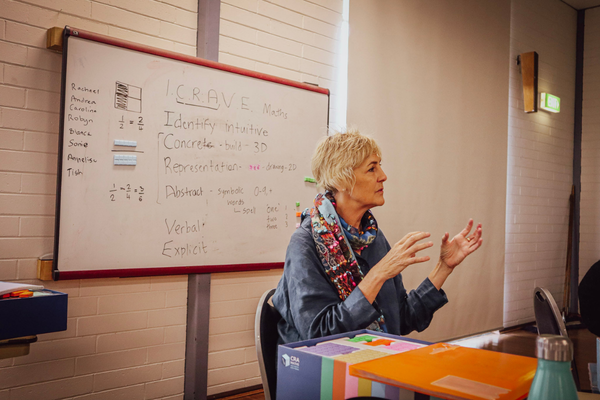
Within the I-CRAVE Maths® Methodology, regrouping instruction follows a carefully sequenced pathway from concrete understanding towards abstract notation.
Students first identify and build quantities physically.
They use manipulatives such as counters, bead strings, MAB blocks, bundled sticks, or ten frames to model number relationships directly.
For example, when solving:
27 + 8
students may physically build 27, then add 8 ones.
As the ones are combined, students can see that ten ones can be exchanged for one ten.
This concrete exchange is critical.
Without it, regrouping often becomes a memorised procedure disconnected from quantity.
Students are also encouraged to verbalise mathematical thinking clearly throughout the process.
Instead of saying:
"Carry the one."
Teachers might say:
"We exchanged ten ones for one ten."
This language reinforces quantity relationships rather than procedural scripts.
Once concrete understanding becomes secure, students move into representation.
They draw the manipulatives, sketch number relationships, and connect physical experiences to visual models and equations.
Only then does abstract notation become stable and meaningful.
What This Looks Like in Practice
In classrooms where regrouping makes sense to students, instruction often moves more slowly initially but far more securely over time.
A Year 1 or Year 2 teacher may spend considerable time building combinations to ten using counters and ten frames before formal regrouping algorithms are introduced.
Students physically reorganise quantities repeatedly until the structure of ten becomes familiar.
In Year 3 classrooms, regrouping in addition might begin with MAB blocks before students ever record a vertical algorithm.
Students physically combine quantities, exchange groups, and describe what is happening verbally before moving into symbolic notation.
Subtraction follows a similar process.
Rather than immediately introducing "borrowing," students physically exchange one ten for ten ones using materials.
This matters because many students can imitate procedures without understanding them.
In intervention settings, older students often require this same concrete rebuilding process.
A Year 5 student struggling with subtraction may still have fragile place value understanding underneath the procedure.
When these foundations are rebuilt concretely, many students begin understanding regrouping far more quickly than expected.
In homeschool settings, manipulatives also provide parents with clearer insight into student thinking.
A child who repeatedly recounts individual units rather than recognising grouped quantities reveals important information about where understanding is breaking down.
Why Explicit Instruction Still Matters
Hands-on learning alone is not enough.
Students also need explicit teaching.
Sometimes manipulatives are introduced without clearly connecting them to mathematical language and symbolic understanding. In these situations, students may complete activities without fully understanding the concepts they represent.
Explicit instruction bridges this gap.
Teachers model thinking carefully. They explain why exchanges happen during regrouping. They guide practice step by step while checking understanding continuously.
This reduces hidden assumptions and allows students to focus on meaning rather than memorising disconnected rules.
For students experiencing maths difficulty, this clarity is especially important.
Why This Approach Works
Research from cognitive science consistently supports explicit, carefully sequenced maths instruction.
Cognitive Load Theory reminds us that working memory is limited. When students must simultaneously manage symbols, procedures, place value relationships and quantity exchange, learning often becomes fragile.
Concrete materials reduce that cognitive load because mathematical structure becomes visible.
Students no longer need to hold every relationship mentally while learning a new procedure.
The Science of Learning also highlights the importance of retrieval, repetition and cumulative review.
This is especially important within an RTI (Response to Intervention) framework.
Students who miss foundational number understanding early often continue accumulating difficulty in later mathematics. Identifying and rebuilding these gaps explicitly can prevent years of ongoing frustration.
Importantly, intervention should not mean simplifying maths indefinitely.
It should mean improving instructional clarity.
What Changes for Teachers
When teachers understand how to teach regrouping with manipulatives conceptually, instruction becomes more predictable and far less frustrating.
There is less guessing about why students continue making errors.
Patterns become easier to recognise.
A student repeatedly making regrouping mistakes may still have weak place value understanding. Another may not yet understand unit exchange conceptually.
This clarity changes instructional decisions.
Teachers become more confident about when to revisit concrete learning, when students are ready for abstraction, and how to respond when confusion appears.
Students also begin explaining their thinking more confidently because the mathematics feels organised rather than arbitrary.
Most importantly, algorithms become connected to understanding rather than memory alone.
Maths Should Make Sense
Addition and subtraction regrouping sit on top of deep place value understanding.
When students are taught only procedural shortcuts, many continue carrying confusion underneath even when answers appear correct temporarily.
When regrouping is taught through concrete experience, explicit instruction and careful sequencing, students are far more likely to develop understanding that lasts.
The goal is not simply correct algorithms.
The goal is helping students understand how numbers work.
Maths should not feel like a series of disconnected rules to memorise.
It should feel logical, visible and understandable.
Maths Australia provides practical, research-informed training that shows educators exactly how to teach maths with clarity and confidence using the I-CRAVE Maths® Methodology.
If you're working with students who are disengaged, stuck or missing foundations, explore our educator training and accreditation pathways.
Learn more at mathsaustralia.com.au/training.