
When Maths Practice Turns Into Daily Frustration
Many homeschool parents reach a point where maths lessons begin feeling heavier than they expected.
A child who once enjoyed early counting activities suddenly resists addition and subtraction practice altogether. Worksheets become exhausting. Simple number facts seem inconsistent from one day to the next.
Some children memorise answers temporarily but forget them quickly. Others rely heavily on finger counting long after repeated practice.
Parents often respond by increasing repetition.
More worksheets.
More flashcards.
More correction.
But many children are not resisting maths because they dislike learning.
They are struggling because the maths itself does not yet make sense.
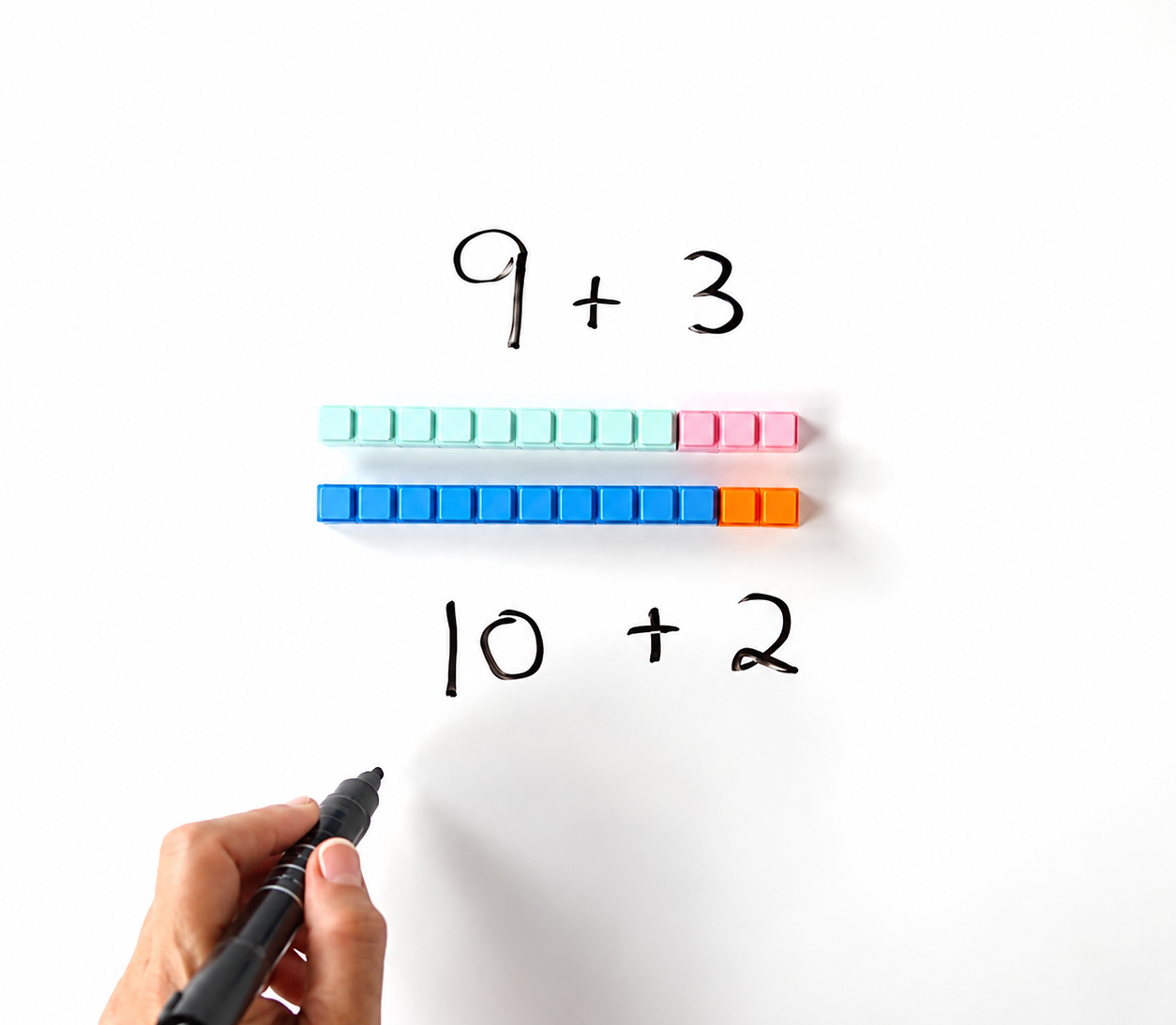
This is where homeschool addition games using blocks can make an important difference. When children experience addition and subtraction physically before working abstractly, number relationships become clearer, more stable, and far less stressful to manage mentally.
The Goal Is Understanding, Not Faster Recall
One of the most common misconceptions in early maths instruction is assuming that fluency develops primarily through repetition.
Certainly, practice matters.
But fluency built without understanding is often fragile.
A child may memorise that 8 + 7 = 15 while still lacking understanding of how quantities combine, separate, and reorganise.
This becomes visible when problems change slightly or unfamiliar questions appear.
Children who truly understand number relationships can think flexibly.
Children relying only on memorisation often become uncertain very quickly.
Addition and subtraction are not simply procedures to remember.
They are relationships between quantities.
This is why effective homeschool addition games focus less on speed and more on helping children see and experience mathematical structure.
Why Blocks Matter in Early Addition and Subtraction
Blocks and concrete materials help make number relationships visible.
Children can physically combine groups, separate quantities, compare amounts, and exchange units rather than trying to imagine these relationships entirely mentally.
This matters because young learners are still developing abstract thinking.
Within the I-CRAVE Maths® Methodology, students move carefully from concrete experience towards representation and abstract notation.
Children first identify quantity physically.
They manipulate objects, move groups, build collections, and verbalise mathematical thinking while working with real materials.
Blocks are particularly effective because they provide immediate visual and physical feedback.
A child solving 6 + 4 can physically combine groups and see the new quantity forming.
A child solving 12 – 5 can remove blocks and observe the difference remaining.
These experiences build understanding far more effectively than memorising isolated facts alone.
What Makes a Maths Game Actually Useful
Not all maths games strengthen understanding.
Some simply disguise rote repetition inside competitive activities.
Effective homeschool addition games do something different.
They make mathematical relationships visible.
They slow thinking down enough for children to notice patterns and structure.
They also provide opportunities for verbal reasoning.
For example, a child using blocks to build number combinations may begin noticing that 7 + 3 creates the same quantity as 3 + 7.
Another may recognise that subtraction can represent removing, comparing, or finding the missing part depending on the situation.
These observations matter because they help children build flexible number sense rather than memorising disconnected facts.
Importantly, the goal is not entertainment for its own sake.
The goal is meaningful engagement with mathematical relationships.
Using Concrete, Representational, and Abstract Learning
Within the I-CRAVE Maths® Methodology, children move gradually through Concrete, Representational, and Abstract learning stages.
In the concrete stage, children physically manipulate materials.
A homeschool parent might use connecting cubes, wooden blocks, counters, or MAB blocks during addition and subtraction games.
Children combine groups, separate quantities, build doubles, or model missing-part problems physically.
Verbal language remains important throughout this process.
Instead of simply asking for the answer, parents can encourage children to describe what they notice:
- “You had eight blocks and added two more.”
- “You exchanged one ten for ten ones.”
This verbal component strengthens understanding because children begin linking mathematical language to physical action.
Once children become secure concretely, they move into representation.
They draw the blocks. They sketch quantities. They connect physical experiences to diagrams, number lines, and equations.
Only then does abstract notation begin carrying stable meaning.
Without these earlier stages, many children attempt to memorise symbols before understanding what the numbers actually represent.
What This Looks Like in a Homeschool Setting
In many homeschool environments, maths becomes calmer once concrete games replace constant worksheet correction.
A parent might play a simple “build the total” game using blocks and number cards.
The child draws two numbers, builds both quantities physically, combines them, and explains what happened verbally before recording the equation.
Subtraction games can work similarly.
A child may begin with a block tower, remove a quantity, and describe the change aloud before writing the matching number sentence.
These activities often reveal misunderstandings quickly.
A child who repeatedly recounts every block from one rather than recognising quantities automatically may still need stronger number sense foundations.
A child struggling with subtraction may actually be uncertain about part-whole relationships rather than the procedure itself.
Because homeschool settings allow close observation, parents are often able to identify these gaps earlier and respond more directly.
Over time, many children begin approaching maths with greater confidence because the numbers themselves start making sense.
Why Explicit Instruction Still Matters
Hands-on learning alone is not enough.
Children also need clear and explicit instruction.
Sometimes parents assume that if a child is using materials, understanding will naturally follow. In reality, children benefit greatly from guided explanations and carefully sequenced modelling.
Explicit instruction helps children connect physical experiences to mathematical ideas.
Parents model thinking aloud.
They explain why quantities change. They describe relationships clearly. They guide children through structured practice while checking understanding carefully.
This reduces hidden assumptions and allows children to focus on meaning rather than guessing.
For children experiencing maths difficulty, this clarity becomes especially important.
Why This Approach Works
Research from cognitive science consistently supports explicit, carefully sequenced maths instruction that moves from concrete experience towards abstraction.
Cognitive Load Theory reminds us that working memory is limited.
When children must manage symbols, procedures, vocabulary, and quantity relationships simultaneously, learning often becomes fragile.
Blocks and concrete materials reduce that cognitive demand because the mathematics becomes visible.
Children no longer need to imagine every relationship mentally.
The Science of Learning also highlights the importance of retrieval, repetition, and cumulative review.
Children need repeated opportunities to revisit addition and subtraction concepts across different contexts over time.
This is especially important within an RTI (Response to Intervention) framework.
Children who miss foundational number understanding early often continue accumulating difficulty in later mathematics. Rebuilding understanding concretely can prevent years of ongoing frustration.
Importantly, intervention does not mean simplifying maths indefinitely.
It means improving instructional clarity.
What Changes for Homeschool Parents
When parents understand how to use homeschool addition games meaningfully, maths instruction often becomes far less stressful.
There is less pressure to rush towards memorisation before understanding is secure.
Parents become more confident recognising why errors occur.
A child relying heavily on finger counting may still need stronger quantity recognition. A child struggling with subtraction may still be uncertain about part-whole relationships.
This clarity changes instruction.
Parents become more confident about when to revisit concrete materials, when children are ready for abstraction, and how to respond when confusion appears.
Children also begin explaining their thinking more confidently because maths starts feeling organised rather than unpredictable.
Most importantly, learning becomes connected to understanding instead of memory alone.
Maths Should Feel Understandable
Addition and subtraction are foundational concepts that shape how children experience maths for years to come.
When instruction focuses only on memorisation and speed, many children cope temporarily while carrying confusion underneath.
When children experience numbers physically, visually, verbally, and symbolically, understanding becomes far more secure.
This is why meaningful homeschool addition games using blocks remain so valuable.
The goal is not simply keeping children entertained.
The goal is helping children understand how numbers work.
Maths should not feel like a collection of disconnected facts to memorise.
It should feel logical, visible, and understandable.
Ready to Strengthen Your Maths Teaching?
Maths Australia provides practical, research-informed training that shows educators exactly how to teach maths with clarity and confidence using the I-CRAVE Maths® Methodology.
If you're working with students who are disengaged, stuck, or missing foundations, explore our educator training and accreditation pathways.
Learn more at mathsaustralia.com.au/training.